

Last updated: October 28, 2026
Key Takeaways
- The biggest Diwali decor mistake is buying items first and planning later. Pick one colour palette (two colours + one metallic) and decorate in five layers of light — threshold, ambient, accent, puja, outdoor — for a home that feels designed instead of decorated.
- Diwali 2026 is on Sunday, November 8. Starting around October 29, a 10-day countdown (declutter → lights → flowers → diyas) keeps the work small and the fresh flowers actually fresh.
- The 2026 trends worth following: eco-friendly materials (clay diyas, biodegradable rangoli, fabric lanterns), warm layered lighting, jewel tones and earthy palettes, and geometric or floral rangoli over messy powder-heavy designs.
- Three budget tiers: a ₹500 refresh (diyas + fairy lights + marigold strings), a ₹2,000 makeover (add torans, urlis, cushion covers), and a ₹5,000 full transformation (add lanterns, textiles, and a puja-corner upgrade). Prices are approximate street/market ranges.
- Reuse beats repurchase: fabric torans, LED diyas, and metal lanterns bought once serve five Diwalis — the cheapest decor is the kind you already own.
Why most Diwali decor looks random (and the fix)
Walk into most homes on Diwali night and you will see the same pattern: diyas on every surface, a string of lights wherever a socket was free, a toran that does not match the cushions, and a rangoli half-hidden behind a shoe rack. Nothing is wrong with any single item — the problem is that they were bought one by one, with no plan connecting them.
Professional decorators do not start with items. They start with three decisions: a palette, a lighting plan, and a timeline. That is the whole method. Everything in this guide follows from those three decisions, and none of it requires a decorator’s budget.
Decision 1: Pick your palette (two colours + one metallic)
The 2026 decor conversation has settled into a few clear directions. Pick one lane and stay in it — a room with three competing colour schemes always looks busier than a room with one:
- Warm jewel tones. Deep maroon, emerald green, royal blue with mustard gold. Rich without being loud; works in both traditional and modern homes.
- Soft neutrals with gold. Cream, beige and ivory with brass or gold accents. Calm, elegant, and the easiest to shop for.
- Earthy festive. Terracotta, rust, olive and deep teal. Pairs beautifully with clay diyas, jute and wooden decor — the most on-trend lane this year.
- Pastel festive. Blush pink, sage green, powder blue with gold. Lighter, more modern; good for small apartments that dark colours would shrink.
Whichever you choose, the rule is the same: two main colours, one metallic accent (gold, brass or copper). Your diyas, toran, cushion covers and rangoli should all speak the same palette.
Decision 2: The 5-layer lighting method
Diwali is the festival of lights, so lighting is the skeleton of the whole decoration. Instead of placing lights wherever they fit, build them in five layers:
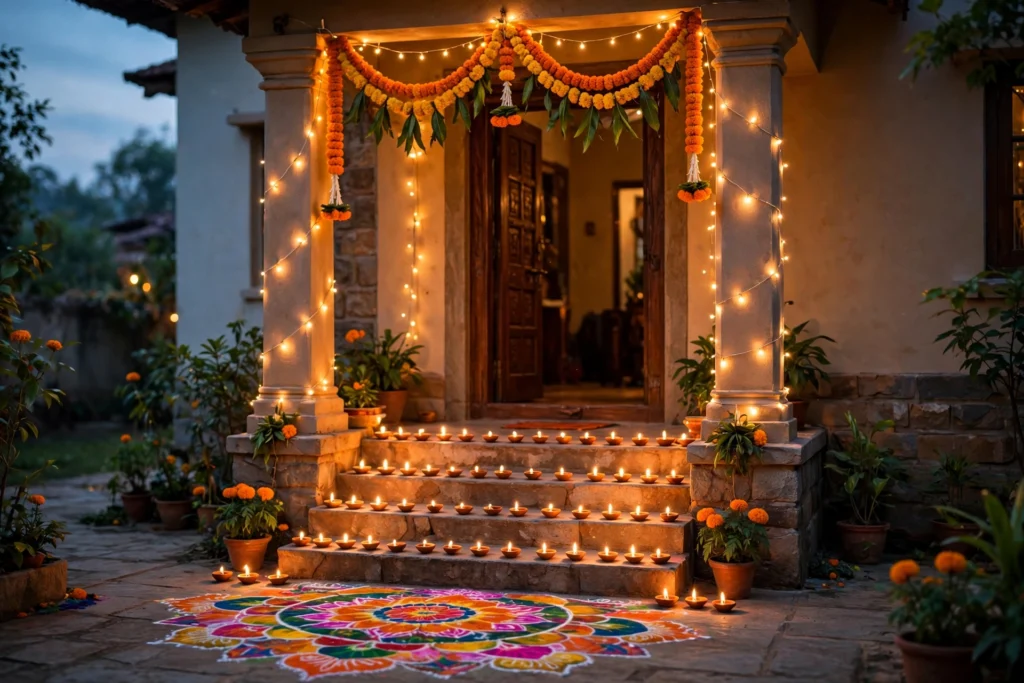
- Layer 1 — The threshold. The entrance is the first thing anyone sees. Diyas along the doorstep, a toran above the door, warm fairy lights around the frame. If you decorate nothing else, decorate the entrance properly — it sets the tone for the entire home.
- Layer 2 — Ambient light. The general glow of the living room and main spaces: string lights along curtain rods, balcony railings and bookshelves. Keep it warm white or soft yellow — cool white light feels harsh against festive colours.
- Layer 3 — Accent light. Two or three focal points that draw the eye: a brass urli with floating flowers and candles, a cluster of geometric metal lanterns in a corner, a lit rangoli. Accents are what make a room feel “designed”.
- Layer 4 — The puja corner. Lakshmi Puja is the spiritual centre of the festival. This layer is deliberate and uncluttered: the main diya, a few supporting diyas, fresh flowers, and nothing that competes for attention.
- Layer 5 — Outdoor light. Balcony, terrace or garden: fairy-light canopies, lanterns, diyas along the parapet. From the street, this is what makes your home part of the festival.
Build the layers in order. Each one takes under an hour. Together they create depth — the difference between “lights everywhere” and “this home glows”.
Decision 3: The 10-day countdown plan
Decorating the whole house in one evening is how things get broken and tempers get short. Diwali’s five-day festival itself runs November 6–10, so spreading the work over the ten days before keeps everything manageable — and means your fresh flowers are actually fresh on the main night:
- Day 10–8 (Oct 29–31): Declutter and deep-clean. Festive decor on top of clutter just looks like more clutter. Do the pre-Diwali cleaning properly first — if a whole-house clean feels big, a structured weekend declutter gets you most of the way there.
- Day 7–5 (Nov 1–3): Shop and prep. Buy what you need in one trip (see the budget tiers below), pull last year’s reusables out of storage, and do any DIY — painted diyas and paper lanterns need drying time. Our beginner DIY decor projects are perfect for this window.
- Day 4–3 (Nov 4–5): Hang lights and torans. Layers 2 and 5 go up first — string lights, lanterns, door hangings. These are the labour-heavy layers; do them while you still have energy.
- Day 2 (Nov 6, Dhanteras): Rangoli and flowers. Rangoli at the entrance, marigold strings, fresh flowers in the urli. Flower rangoli and petal designs last 2–3 days; powder rangoli lasts longer but smudges.
- Day 1 (Nov 7–8): Diyas and the puja corner. The final layer goes up on Choti Diwali and the main night. Clay diyas, the main puja diya, floating candles — everything fresh, everything lit.
Room by room: where each layer goes
The entrance (Layer 1)
This is the one room worth over-investing in. A rangoli at the door — floral in a shallow brass urli if you want low maintenance — framed by diyas, a fresh marigold toran above the doorway (fabric or beaded torans last the whole season and store for next year), and warm fairy lights outlining the frame. Polish the nameplate. It costs almost nothing and it is the first impression.
The living room (Layers 2 and 3)
You do not need new furniture. Festive cushion covers and a table runner in your palette, a brass urli with floating marigolds as the centrepiece, string lights along the curtain rod, and one accent corner — a cluster of lanterns or a lit shelf. If the sofa is the weak point, small upgrades like these lift a whole room for very little money.
The puja corner (Layer 4)
Keep this layer calm. A clean cloth in your palette, the main diya plus a few supporting diyas, fresh flowers, and the idols or photos arranged with breathing room. Resist the urge to add fairy lights here — the puja corner should feel serene, not busy. LED diyas are a practical choice around fabrics and with children nearby; keep a few traditional clay diyas for the main aarti.
Balcony and outdoors (Layer 5)
A string-light canopy across the balcony, lanterns hung at different heights, and diyas along the parapet wall. This layer is visible from outside, so it is also the one your neighbours and passers-by enjoy. Solar fairy lights work well here and cost nothing to run.
The eco-friendly Diwali (2026’s biggest trend)
The strongest decor trend this year is also the most sensible: stop buying single-use plastic decor. The eco-friendly swaps are not a compromise — they mostly look better:
- Clay diyas over plastic or metal ones. Handmade, biodegradable, and they support local potters. Paint a few yourself for a personal touch.
- Biodegradable rangoli. Flower petals, turmeric, rice flour and coloured sand instead of synthetic colours. A floral rangoli in an urli can be refreshed with new petals daily.
- Fabric lanterns and torans. Cloth lanterns and fabric torans store flat and come back out next year — unlike paper ones that tear in storage.
- LED diyas for the risky spots. Around curtains, with kids and pets, or left unattended — LED diyas are safer and reusable. Use traditional diyas where you can watch them.
- Upcycled glass-bottle lanterns. Old bottles + fairy lights + twine = lanterns that cost nothing and look handmade in the best way.
Three budget tiers (approximate market ranges)
Prices below are approximate street and market ranges in India, late October — they move with the city and the week, so treat them as planning guides, not quotes:
- ₹500 — the refresh. A dozen clay diyas, one string of warm fairy lights, and marigold strings for the entrance. This covers Layer 1 and the start of Layer 2, and honestly, a well-done entrance plus warm lights is 70% of the festive feeling.
- ₹2,000 — the makeover. Add a fabric toran, a brass or steel urli, two cushion covers in your palette, and a set of LED diyas. This completes Layers 1–3 in the living room and entrance.
- ₹5,000 — the transformation. Add metal lanterns, a table runner and fresh textiles, a puja-corner upgrade (new cloth, brass diya set, fresh flowers across the five days), and outdoor string lights for Layer 5. At this tier, buy reusables — fabric, metal, LED — so next year’s Diwali costs you almost nothing.
Safety: the unglamorous layer
Every Diwali, fire services report the same preventable accidents. Keep flames away from curtains, sofas and paper decor. Do not overload sockets — spread string lights across multiple outlets, and use certified lights. Switch off all electrical decor before sleeping. Keep a bucket of water or sand near the puja corner when diyas are lit. None of this is festive, and all of it matters more than any decoration.
Frequently Asked Questions
When should I start decorating for Diwali 2026?
Diwali 2026 is on Sunday, November 8. Start cleaning and planning around October 29, hang lights and torans by November 4–5, and add fresh flowers and diyas on November 6–8. The 10-day countdown in this guide keeps each step small.
What are the biggest Diwali decoration trends in 2026?
Eco-friendly materials (clay diyas, biodegradable rangoli, fabric lanterns), layered warm lighting, jewel-tone and earthy colour palettes like terracotta and deep teal, geometric and floral rangoli designs, and reusable decor bought once and stored for years.
How can I decorate for Diwali on a small budget?
A ₹500 refresh covers the highest-impact items: clay diyas at the entrance, one string of warm fairy lights, and marigold strings. Reuse last year’s torans and lanterns, make a few items by hand, and put the effort into the entrance and living room — those two spaces carry the whole festive feeling.
Are LED diyas better than traditional clay diyas?
They solve different problems. Clay diyas are traditional, biodegradable and beautiful — use them for the puja and where you can watch them. LED diyas are safer around children, pets and fabrics, and they are reusable. Most homes sensibly use both.
Which colours work best for Diwali decor this year?
Classic red, gold and orange never go wrong. For 2026, the trending lanes are jewel tones (emerald, burgundy, royal blue), earthy shades (terracotta, rust, olive) and pastel festive (blush pink, sage green) — each paired with one metallic accent like gold or brass.